
Introduction: A New Era of AI Has Arrived
For the past few years, artificial intelligence has dominated global conversations, from ChatGPT’s rise to breakthroughs in robotics, automation, and generative AI. But in 2024–2026, a new frontier has emerged—Agentic AI, also known as Autonomous AI Agents.
Unlike traditional AI chatbots that respond when prompted, Agentic AI acts on its own, analyzes objectives, creates plans, executes multi-step workflows, and makes decisions without constant human supervision.
Think of it like this:
Old AI:
➡️ You give a command → AI returns a response.
Agentic AI:
➡️ You set a goal → AI plans, executes, improves, and completes the entire workflow automatically.
This shift is not just technological—it’s economic, cultural, and deeply transformative. And nowhere is this revolution happening faster than in the United States, where businesses, startups, creators, and researchers are integrating agentic systems into everyday workflows.
In this comprehensive USA-focused guide, we’ll explore:
✔ What Agentic AI actually is
✔ Why the USA is leading the adoption
✔ Real-world examples across industries
✔ How autonomous AI boosts productivity
✔ Economic impact and future job landscape
✔ Benefits, risks, and ethical challenges
✔ The future of autonomous AI agents (2026–2030)
Let’s dive in.
1. What Is Agentic AI? (Simple Definition for Everyone)
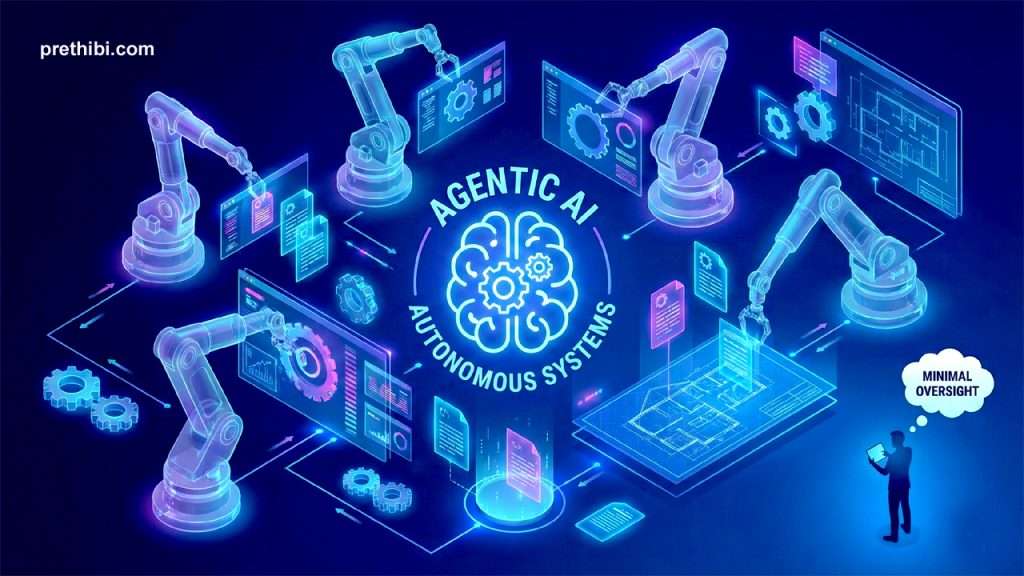
Agentic AI refers to AI systems that can independently plan, act, and complete multi-step tasks based on a specific goal—without requiring humans to guide each step.
These AI agents can:
- Understand complex objectives
- Break tasks into smaller actions
- Seek information on their own
- Execute actions across apps
- Learn from outcomes
- Improve future performance
- Operate continuously
In other words, instead of giving instructions repeatedly, you simply define an outcome—and the AI does the rest.
Examples of Agentic AI Tasks
- Researching a topic, writing a report, and formatting it
- For businesses: completing customer onboarding workflow
- For programmers: writing, testing, and deploying code
- For marketing: creating, scheduling & optimizing content
- For finance: analyzing markets and generating insights
- For personal use: organizing files, reminders, or travel plans
Agentic systems act more like digital employees rather than tools.
2. Why the USA Is Rapidly Adopting Agentic AI
The United States is currently the biggest driver of agentic AI development and adoption. Several factors contribute:
A. Cutting-Edge AI Research Hubs
USA hosts top AI labs:
- OpenAI
- Google DeepMind USA
- Anthropic
- Meta AI
- Microsoft AI
These organizations are building foundational models that power agentic systems.
B. Tech-Forward Business Culture
US companies aggressively adopt technologies that cut costs and boost efficiency. Startups especially benefit from AI automation.
C. Huge AI Investment
The USA invested over $300 billion (private + public) into AI R&D from 2023–2025.
D. Startup Innovation
Silicon Valley and Austin lead agentic tool innovation:
- Devin AI (autonomous software engineer)
- AutoGPT
- Taskade AI agents
- Cognosys
- ReAct AI frameworks
E. Workforce Demand for Automation
Remote work, creator economy growth, and gig economy expansion have increased demand for automated digital assistants.
Read More- AI-Powered Trip Planning in 2026: How Generative AI Is Transforming Travel for Americans
3. How Agentic AI Works (Step-by-Step)
At the core of agentic AI are three main components:
1. Perception
The AI interprets the goal or input.
Example:
“Create a full marketing campaign for our new product.”
2. Planning
The AI breaks the goal into steps:
- Market analysis
- Competitor research
- Audience targeting
- Content calendar
- Drafting posts
- Scheduling automation
3. Action
The agent executes tasks across tools:
- Using APIs
- Browsing web pages
- Generating images
- Writing emails
- Editing spreadsheets
- Running code
- Completing forms
4. Reflection & Improvement
The agent evaluates results and optimizes future behavior—like a self-improving system.
4. Real-World Use Cases of Agentic AI in the USA
Agentic AI isn’t science fiction—it’s already being used in U.S. industries.
A. Software Engineering
Tools like Devin AI and GitHub Copilot Agents can:
- Write entire applications
- Fix bugs
- Run tests
- Deploy code
- Document systems
- Monitor performance
This accelerates development for US startups and enterprise teams.
B. Digital Marketing & Content Creation
AI agents can:
- Generate SEO content
- Create YouTube scripts
- Design social media posts
- Automate publishing
- Track analytics
- Optimize campaigns
US marketing agencies are cutting workload by 40–60% using agentic systems.
C. Business Operations Automation
AI agents perform:
- Customer support workflows
- HR onboarding
- CRM updates
- Finance reporting
- Email automation
- Inventory management
SMEs in the USA save thousands in manual labor costs.
D. E-Commerce & Retail
AI can:
- Update product listings
- Optimize pricing
- Manage ads
- Track supply chain issues
- Chat with customers
- Reduce returns
Major players like Amazon and Walmart are experimenting heavily.
E. Healthcare & Biotech
Autonomous agents support:
- Medical research
- Drug discovery simulations
- Lab automation
- Patient appointment systems
- Insurance claims processing
Biotech labs in Boston and California use AI agents to run experiments.
F. Financial Services
AI agents handle:
- Stock analysis
- Market predictions
- Portfolio management
- Risk assessment
- Compliance tasks
FinTech companies in New York and San Francisco benefit the most.
5. Benefits of Agentic AI for USA Businesses and Individuals
1. Massive Productivity Boost
Tasks that took hours can now be completed in minutes.
2. Cost Reduction
Businesses reduce workforce burdens and automate repetitive processes.
3. 24/7 Operations
AI agents never sleep, take breaks, or lose focus.
4. Enhanced Accuracy
Fewer human errors in calculations, coding, or documentation.
5. Personalized Automation
AI adapts to each user’s preferences.
6. Faster Innovation
US startups build and test ideas rapidly, giving them competitive advantages.
6. Challenges & Ethical Concerns
While the benefits are impressive, concerns exist.
A. Job Displacement
Many low-skill or repetitive jobs may be automated.
However, new jobs will also emerge:
- AI supervisors
- Prompt engineers
- AI auditors
- Automation specialists
- Data architects
B. Systemic Bias & Accuracy Issues
If trained on biased datasets, AI decisions can become unfair.
C. Privacy & Security Risks
Autonomous agents with access to apps and data must be monitored closely.
D. Over-reliance on AI
Humans may lose decision-making abilities if they depend too heavily on agents.
E. Regulation Challenges
US policymakers are still catching up with technology—leading to unclear rules.
Must Read- The Rise of the Micro-Cation USA: How Americans Are Maximizing Time Off & Budget
7. The Future of Agentic AI (2026–2030)
Experts predict that by 2030:
✔ Most businesses in the USA will have autonomous AI employees
Like an AI HR Manager, AI Accountant, AI Customer Service Rep.
✔ Personal AI Agents will be mainstream
Everyone will have a personalized autonomous assistant similar to:
- A digital secretary
- A travel planner
- A fitness & health agent
- A finance manager
- A home automation controller
✔ Agentic Robotics will grow
AI + robots = automated kitchens, manufacturing, elderly care, logistics, and more.
✔ AI-driven micro-businesses
One person with 10–20 AI agents will run companies that used to require 20 employees.
✔ AI Governance will become essential
Monitoring AI behavior will be a major industry in the USA.
8. Should You Use Agentic AI? (Short Answer: YES)
Whether you’re an entrepreneur, content creator, student, or business manager—agentic AI can help you:
- Save time
- Boost income
- Automate work
- Improve productivity
- Scale your online presence
The USA is adopting these tools fastest—so staying ahead is crucial.
9. Best Agentic AI Tools in 2025–2026 (USA Edition)
1. OpenAI Agents
Powerful multi-step automation.
2. Devin AI
The world’s first autonomous software engineer.
3. AutoGPT / BabyAGI / ReAct Agents
Open-source agentic frameworks.
4. Taskade AI Agents
For project management.
5. Replit AI Agent
Code generation and deployment automation.
6. Microsoft Copilot Studio
Enterprise-level agent deployments.
7. Adobe Firefly Agents
For creative workflows.
8. Jasper AI Agents
Marketing and copywriting automation.
⭐ FAQ: Agentic AI & Autonomous AI Agents (USA Edition)
1. What is Agentic AI?
Agentic AI refers to autonomous AI agents that can plan, act, and complete multi-step tasks without needing constant human input. Unlike traditional chatbots, these agents understand objectives, break them into steps, and execute tasks end-to-end.
2. How is Agentic AI different from regular AI tools?
Regular AI tools respond to specific prompts.
Agentic AI takes goals and works independently—researching, executing workflows, making decisions, and improving its results automatically.
3. Why is Agentic AI becoming popular in the USA?
The USA is leading in AI research, startup innovation, cloud infrastructure, and tech adoption. Businesses want automation to increase productivity, lower costs, and stay competitive—making agentic systems highly attractive.
4. Can Agentic AI replace human jobs?
Agentic AI will automate repetitive and routine tasks, potentially reducing certain job roles. However, it will also create new roles such as AI supervisors, prompt engineers, automation architects, and AI ethics auditors.
5. What industries are using Agentic AI in the USA?
Industries adopting agentic AI include:
- Software development
- Digital marketing
- Healthcare
- Finance
- E-commerce
- Customer support
- Manufacturing & logistics
- Real estate & professional services
6. Is Agentic AI safe to use?
Yes, but it requires strong oversight. Users must ensure:
- Data privacy controls
- Access limitations
- Regular monitoring
- Ethical safeguards
- Bias mitigation
AI agents should be supervised the way you supervise an employee.
7. What are examples of Agentic AI tools?
Some popular agentic AI tools include:
- OpenAI Agents
- Devin AI
- AutoGPT & BabyAGI
- ReAct frameworks
- Microsoft Copilot Studio
- Taskade AI Agents
- Jasper AI Agents
- Replit AI Developer Agent
8. Can small businesses in the USA use Agentic AI?
Absolutely. Small businesses benefit the most because agentic AI reduces workload and lowers operational costs. It can automate marketing, scheduling, bookkeeping, customer support, lead generation, and more.
9. Will Agentic AI improve productivity?
Yes—agentic AI can handle repetitive tasks 24/7, produce error-free work, and complete tasks faster than humans. Many U.S. companies report 40–80% time savings after adopting AI agents.
10. Do I need technical skills to use Agentic AI?
No. Many agentic AI platforms are beginner-friendly. You simply describe your goals in natural language, and the agent plans and executes tasks automatically.
11. Can Agentic AI operate across multiple applications?
Yes. Modern AI agents can integrate with apps such as Gmail, Google Sheets, CRM tools, social media platforms, project management systems, and coding environments.
12. Is Agentic AI suitable for content creators?
Definitely. Creators use AI agents to:
- Write blogs
- Make scripts
- Edit videos
- Design graphics
- Schedule posts
- Manage analytics
- Create YouTube content
- Grow social media channels
13. What is the future of Agentic AI?
By 2030, experts expect Agentic AI to become mainstream, with personal AI assistants managing finances, health, communication, and daily tasks. Businesses will rely heavily on autonomous digital employees.
14. Is Agentic AI expensive?
Costs vary. Many tools offer free versions, while advanced enterprise-level agents require subscriptions. Still, most U.S. businesses find that the productivity gains far outweigh the cost.
15. Can Agentic AI run my entire business?
Not entirely yet—but we are getting close.
AI agents can manage large portions of operations, including:
- Marketing
- Customer support
- Basic finance
- Lead generation
- Content creation
- Scheduling
- Data analysis
Human supervision is still necessary, but workload is dramatically reduced.
Final Thoughts: The Future Is Agentic
Agentic AI is not just another tech trend—it’s a paradigm shift.
The United States is leading the charge into a future where:
- AI systems act like autonomous digital workers
- Businesses run faster and smarter
- Individuals have powerful personal assistants
- Innovation accelerates like never before
In the next five years, agentic AI will become an everyday part of American life—just as smartphones did a decade ago. Those who learn and adopt these technologies early will have a massive advantage.